The Welsh Baptist Historic District
(period of significance: 1714-1832)by David Hawk
The first Baptist congregation in Wales came together in 1649 during the English Civil War. After the Restoration of the Monarchy in 1660, Parliament passed several laws requiring obedience to the Church of England. There was little tolerance for Dissenters and many Baptists were imprisoned. Baptists in Wales were not numerous, numbering only 500 in 1700, and some, lured by the promise of religious freedom, chose to emigrate to William Penn's colony in America[1].
As is well known, Lord Calvert and William Penn's colonial charters in America overlapped due to the inadequate maps of the time. By 1701, Calvert's challenges were occupying much of Penn's attention. Penn undertook an audacious effort to establish "facts on the ground" by issuing several land grants intended to lure (his) settlers into the disputed area[2]. Many of these grants directly infringed on earlier Calvert grants[3]. Penn's land grants along the border that year included Penny Acre (1100 acres) and the Welsh Tract (30,000 acres) at Iron Hill, both in what Penn then considered to be (his) New Castle County[4].
That same year, sixteen members of an emigrant Baptist church from South Wales disembarked at Philadephia from the ship James and Mary and joined fellow Baptists from England and Ireland at Pennepeck (modern-day Bustleton), about eleven miles north of Philadelphia. Within a few years, however, an irreconcilable doctrinal dispute had arisen concerning the "Laying on of hands"[5] - the Welsh Baptists considered it essential but the others were opposed, so in 1703 the Welsh, now grown to thirty-eight in number, departed for the aforementioned Welsh Tract where they established the Welsh Tract Baptist Church[6] (and incidentally strengthening William Penn's claims along the frontier with Maryland).
John Evans Sr arrived from Radnorshire in Wales some time between 1695 and 1700[7]. He was probably a Quaker at that point since he didn't join the Baptists at Pennepeck but instead headed to Radnor[8], about fourteen miles west of Philadelphia, where other Welsh Quaker immigrants had settled[9]. During his time there he arranged the purchase of his 300-acre tract in Penny Acre out on the frontier with Maryland. After moving there, his affinity for his fellow Welsh seems to have outweighed his affinity for Quakerism as he chose to be baptized into the Welsh Tract Baptist Church in 1710 rather than joining the Nottingham Quaker Meeting (neither was nearby, being seven and nine miles distant from Penny Acre respectively).
Sometime after moving to Penny Acre, John Evans took an interest in a valuable potential mill seat about three miles away on a bend of the White Clay Creek near the confluence of the East and Middle branches. In 1714 he purchased the site - 100 acres of Stenning Manor then owned by William Penn Jr.[10] - and built his grist and saw mill there. This mill proved to be quite successful and provided prosperity for the Evans family for several generations. Around 1722 either he, or more likely his son John Evans Jr., purchased an additional 200 acres upstream from his grist mill from the London Company and built a fulling mill[11].
The Evanses encouraged their brethren from the Welsh Tract Baptist Church to purchase farms around the new mills, and many did so, thereby forming the Welsh Baptist community that became London Britain Township in 1725. That year enough Baptists had moved into the area that a meeting house, probably log, was constructed and organized as a daughter church of the Welsh Tract church. It became an independent congregation in 1780 and survived into the 20th century, last meetings in 1921[12].
Not all early residents of London Britain Township were landowners. Some immigrants from Europe brought with them enough money to purchase farms, but many indentured themselves for several years of labor to pay for their passage. Other early residents were Africans, brought here involuntarily on slave ships. The Evans family were slaveholders and, by the time of the Revolution, were amongst the largest slaveholders in Chester County.
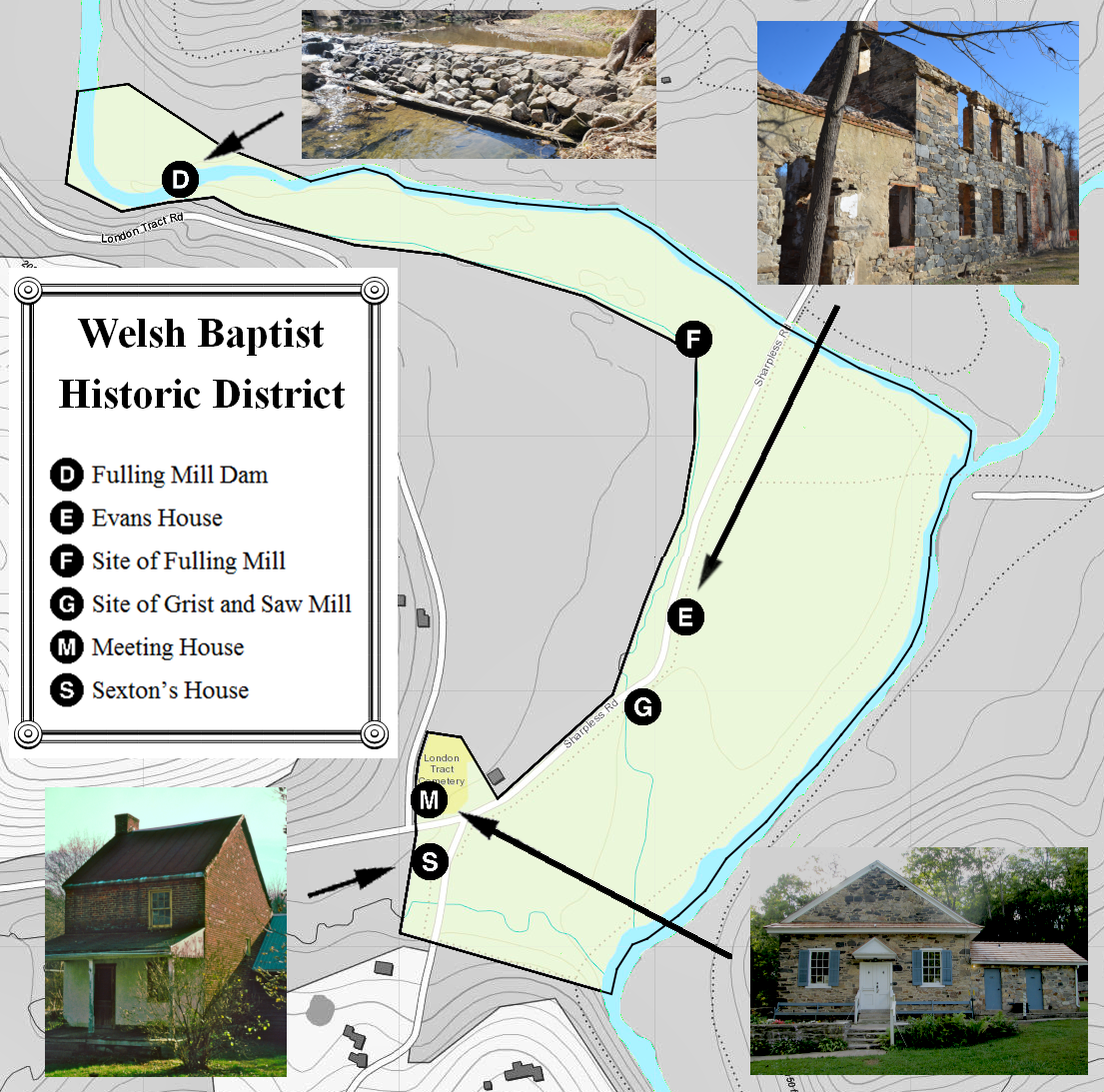
Welsh Baptist Historic District
The legacy of the Welsh Baptists here has been a subject of fascination for area residents for generations. In 2019, after an arsonist torched the Evans House, a group of local residents came together to lobby for the preservation of its still-standing walls. An outgrowth of this effort was the establishment of the Welsh Baptist Historic District, which was declared Eligible for the National Register by the Pennsylvania Historical & Museum Commission in 2021. This effort, a joint project by the Historical Committee of the Friends of the White Clay Creek Preserve and the London Britain Township Historical Commission, was led by Susan Moon with guidance from Karen Marshall, the Chester County Historic Preservation Officer.
Here is told the story of the founders and early settlers of London Britain Township, their church, their mills and the enslaved people that operated them, their contributions to the American Revolution, and their eventual assimilation into the greater American story.
References
| [1] | "The Story of Nonconformity in Wales - Baptists, The Early Dissenters," Addoldai Cymru, The Welsh Religious Buildings Trust, https://welshchapels.wales/nonconformity/test/. ↩ |
| [2] | Cliff Parker, Evans Property - London Britain Township, a report of the Chester County Archives, (unpublished, 2020), p. 3. ↩ |
| [3] | These Calvert grants included Susquehana Manor (32,000 acres in 1680) and New Munster (6000 acres in 1683), both well below the 40th parallel. ↩ |
| [4] | Other Penn grants along the disputed border in 1701 included the Nottingham Lots (18,000 acres) and the London Company Tract (25,200 acres). The boundary dispute was not settled for another sixty-some years when Mason and Dixon drew their famous line. All four of these grants were at least partially re-assigned to Maryland at that time. ↩ |
| [5] | "Laying on of hands", Wikipedia, https://en.wikipedia.org/wiki/Laying_on_of_hands. ↩ |
| [6] | Angela Tweedy and Martha Daniel, "Church History", in London Tract Meeting House Site Study Report, (University of Delaware, Historic Preservation Methods Course, Spring 1997), p. 16. ↩ |
| [7] | The arrival date for John Evans Sr. is in dispute. The family genealogy (Septimus Nivin) says 1695, however Cliff Parker notes that the deed for the first land he purchased in 1700 says he is "late of Radnorshire" suggesting a more recent arrival. ↩ |
| [8] | This is known from a notation on the back of the survey order for his 1700 Penny Acre tract: "write to John Evans at John Richards at the meeting hous Radnor". Jacob and Isaac Taylor Papers, New Castle County Volume, Item 951, Historical Society of Pennsylvania (Collection No. 0651). ↩ |
| [9] | People arriving from Wales tended to sort themselves by religion, Baptists heading initially to Pennepeck and Quakers to Radnor, where they stayed with co-religionists while arranging for their future. ↩ |
| [10] | Septimus E. Nivin, Evans Whitting Davis, (Philadelphia: International Printing Company, 1922), p. 2. ↩ |
| [11] | Nivin, p. 2. ↩ |
| [12] | Tweedy and Daniel, p. 18. ↩ |