The Evans Family and Slavery
Portions written by Julia Hofer, Cliff Parker and David Hawk (ed.).
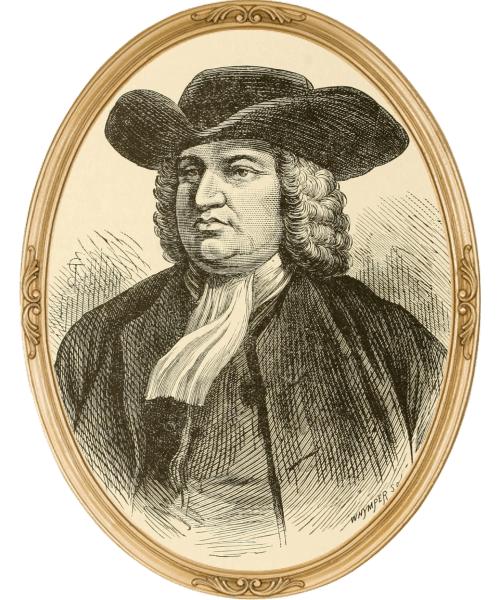 |
Although slavery was not as widespread in colonial Pennsylvania as it was in the south, it was more prevalent than most people today realize. Early Dutch and Swedish colonists imported slaves as early as 1639[1]. In 1684 the slave ship Isabella delivered a cargo of 150 slaves to Philadelphia from Africa and many more followed. William Penn himself owned twelve slaves[2], and Quaker ownership of slaves was not uncommon in the early eighteenth century. Gradually, led primarily by Quakers, there was a moral awakening in Pennsylvania and by the end of the century sentiments had pretty much changed. In 1780, in the midst of the Revolution, Pennsylvania passed An Act for the Gradual Abolition of Slavery[3] and slavery began its excruciatingly slow decline in Pennsylvania. This was a remarkable turnaround for a practice that had had been accepted since before the dawn of Christianity, and how it played out in London Britain Township with the John Evans family is an important part of the story. |
The Evans Family had emigrated from Wales before the turn of the century. Led by John Evans Sr, they established a mill circa 1715 in the area that became the Baptist enclave now known as London Britain Township. Exactly when slavery was introduced into the area is unknown, but John Evans Jr. is the first identified slave-owner in the township. When he died in 1738 his household consisted of more than just his immediate family. Itemized among his goods and chattels are the time remaining on two white servants’ indentures valued at £6 and four enslaved persons “1 negro lad, one negro woman, two small children” valued at £55[4].
As Julia Hofer, in her socio-economic history of the John Evans family[5], explains:
The Welsh made substantial use of indentured labor. Some of these had been servants in Wales and were paying their employers for the cost of passage. When these servants had worked for the required length of time, they were frequently replaced with negro slaves. Black bondsmen were a potential source of labor, but more importantly they provided a partial means of satisfying broadly based social and psychological needs. Because those who purchased slaves were almost always men of wealth and influence, slave ownership came to denote economic success, public prominence, and community leadership. The negro was representative of a certain lifestyle. He was easily recognized, very distinctive, relatively scarce: his very presence suggested leisure, power, and permanence. Other status symbols included a spacious country house, expensive furniture, a silver watch, a showy pacing horse, and an expensive personal wardrobe.[6] "In the rural society of early southeastern Pennsylvania the value of a slave, like the value of various other pieces of personal property depended, in part at least, on his role as a status conferring possession."
Two of John Evans Jr.’s sons, John Evans Esq. and Col Evan Evans, expanded the family’s slaveholdings. As late as 1774 Evan Evans purchased a slave named “Jeak” from the estate of John Henderson, a fellow mill owner in New London Township, for the considerable sum £96.
In 1780 the Pennsylvania General Assembly in Philadelphia passed the Gradual Abolition Act. This was the first such law in the United States, but it was relatively meek in comparison to laws other northern states passed later. It did not immediately free anyone. Instead people enslaved before the passage of the act remained slaves for the rest of their lives if properly registered. It provided that people born of a slave mother after a certain date were not slaves, but rather “servants” until they reached the age of 28 – and only then were they free. The law also forbade the importation of any new slaves into the state[7].
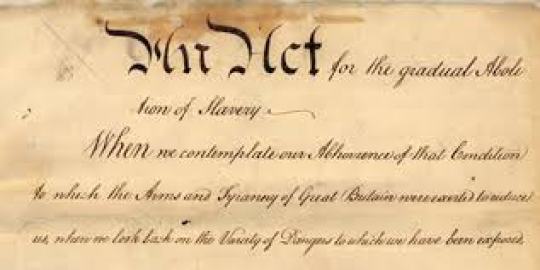
Both John Evans Esq. and Col. Evan Evans registered their slaves to
ensure that they would not lose their “property”. While all four of
John Evans Jr.’s sons served in various capacities during the
Revolutionary War, their support for the ideal that “all men are
created equal” did not extend to the people they held in bondage.
By this time the Evans family was one of the largest slaveholding
families in the county.
The slaves registered by John Evans Esq. in 1780 were[8]:
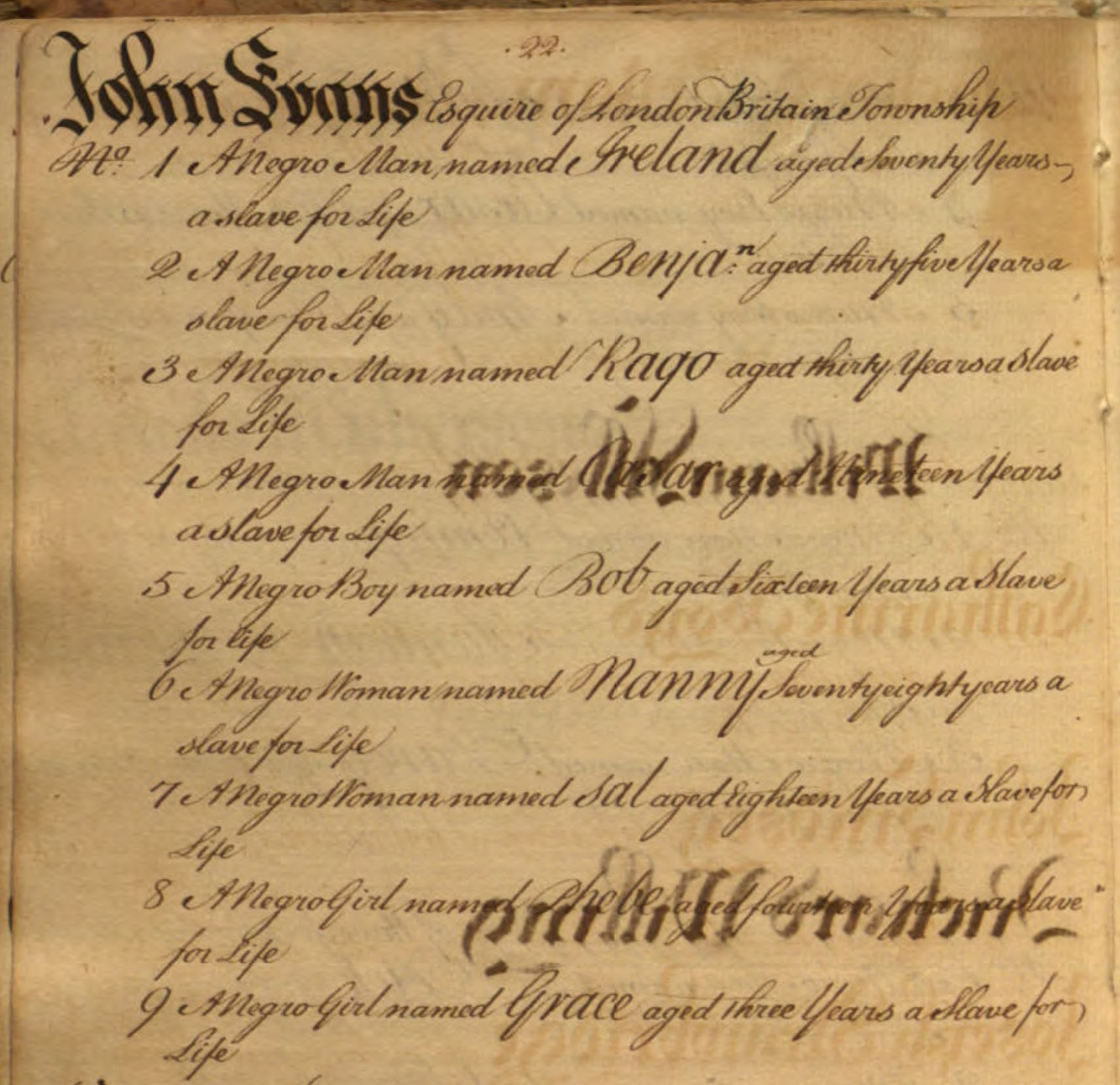
At this time during the Revolution, John Evans Esq. was a newly-appointed justice on the Pennsylvania Supreme Court and resided most of the time at the state capitol in Philadelphia. He still took time to register his slaves back in London Britain Township. The five men may have operated the mill during this time, perhaps assisted by the women. John Evans Esq. registered all his slaves as “Slave for Life”.
The slaves registered by Evan Evans Esq. were[9]:
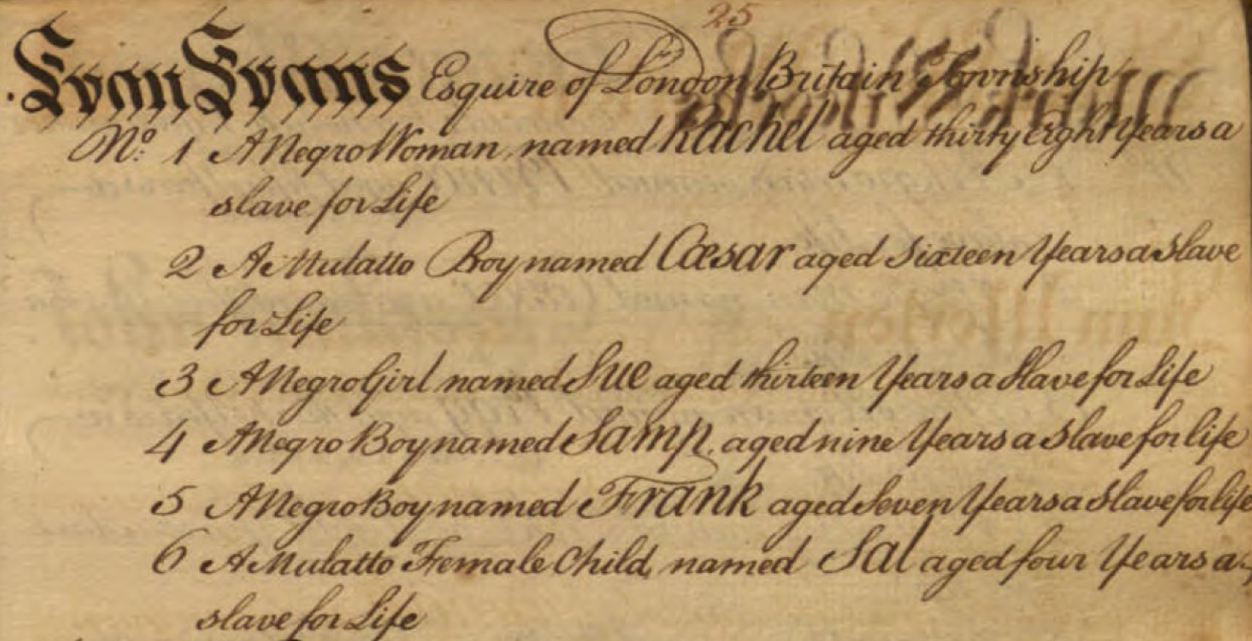
Evan Evans Esq. also registered his slaves as “Slave for Life”. These slaves may have operated the fulling mill.
Popular sentiment had led to the freeing of many blacks in Pennsylvania
even before the passage of the Gradual Abolition Act in 1780,
especially by Quaker slaveholders. By 1790
approximately 64% of all blacks were free, and 97% were free at the
turn of the century[10].
Despite general admonitions from Baptist leaders in Philadelphia, several of the descendants of John Evans Esq. and Col Evan Evans retained ownership of their slaves after passage of the Act[11]. But not all members of the Evans family were unaffected by the sentiments of the day. Two family members, both women, and both independent, did free their slaves.
Mary Evans, unmarried and the sole surviving child of John Evans Esq. who had died in 1783, directed in her final will that:
I will that my negro Sal be set free at my death, and that likewise ten pounds be left in the hands of Mrs. Knarsborough for her use in case of sickness, and that my negro Bob be set free in one year after my decease. I will my girl Grace to the care of Mrs. Knarsborough until the age of eighteen and then free.[12]
Margaret Evans, widow of Col. Evan Evans who had died in 1794, freed her slave Sal.
To all whom it may concern.
This indenture made the fifteenth day of August, one thousand eight hundred.
Witnesseth: That I, Margaret Evans, of the County of Chester and State of Pennsylvania, do of my own voluntary act and at my own proper cost agreeably to the Acts of Assembly for the gradual abolition of slavery in the State of Pennsylvania, manumit and set free a certain mulatto woman named Sal, born in the year 1776, and recorded in the Register’s office for the County of Chester aforesaid, as the slave of Evan Evans, Esq., of London Britain Township, and is now become my property by a bonafide purchase. In testimony whereof I have hereunto set my hand and seal the day and year first written.
Margaret Evans, Seal[13]
The other slaves owned by descendants of John Evans Esq. and Col. Evan Evans were not so fortunate and continued to be held as slaves until they died. It was not until the 1810s that the last of the Evans family slaves passed away.
References
| [1] | Turner, E. R., The Negro In Pennsylvania, Slavery-Servitude-Freedom, 1639-1861, The American Historical Association, (Baltimore: The Lord Baltimore Press, 1912), p. 1. ↩ |
| [2] | https://en.wikipedia.org/wiki/History_of_slavery_in_Pennsylvania ↩ |
| [3] | Alexandria Cannon, “Gradual Abolition Act of 1780”, published on the Mount Vernon website https://www.mountvernon.org/library/digitalhistory/digital-encyclopedia/article/gradual-abolition-act-of-1780/ ↩ |
| [4] | Septimus Nivin, Evans, Whitting, Davis, (Philadelphia: International Printing Company, 1922). p. 11. ↩ |
| [5] | Julia R. Hofer, “The John Evans Family of London Britain Township, Pennsylvania”, May 19, 1987. Written for Dr. Carol Hofeckker as part of her Masters Degree program at the University of Delaware. ↩ |
| [6] | Wayland F. Dunaway, "Early Welsh Settlers of Pennsylvania," Pennsylvania History 12 (October 1945): pp. 264-265. ↩ |
| [7] | This was the provision that caused President George Washington, when he was residing in Philadelphia, then the capitol of the United States, to rotate his slaves back to Mt Vernon every six months to prevent them from being freed. ↩ |
| [8] | Chester County Slave Register, 1780, p. 22. held at the Yale University Library. ↩ |
| [9] | Ibid, p. 25. ↩ |
| [10] | https://en.wikipedia.org/wiki/History_of_slavery_in_Pennsylvania ↩ |
| [11] | It should be noted that John Evans Esq. and Evan Evans Esq. did not register any children born to their slaves after 1780. Under the provisions of the Abolition Act, children born to “slaves for life” would not be free until the age of 28. To take advantage of this provision those children had to be registered with the county. (Cliff Parker) ↩ |
| [12] | Septimus Nivin, p 20. ↩ |
| [13] | Septimus Nivin, p. 23. ↩ |