Sexton's Barn
Architectural Description
by Preston L. Hershey
Historic Preservations Methods Course
Center for Historic Architecture and Design (CHAD)
University of Delaware
April 17, 1997
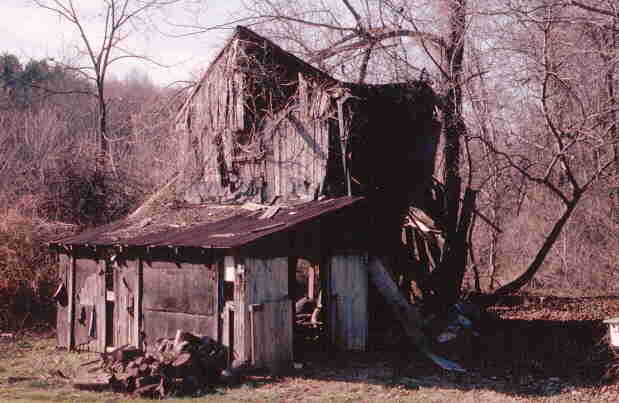
The "now ruinous" barn in the late 1990s prior to
demolition[1]
(photo credit: David Hawk)
|
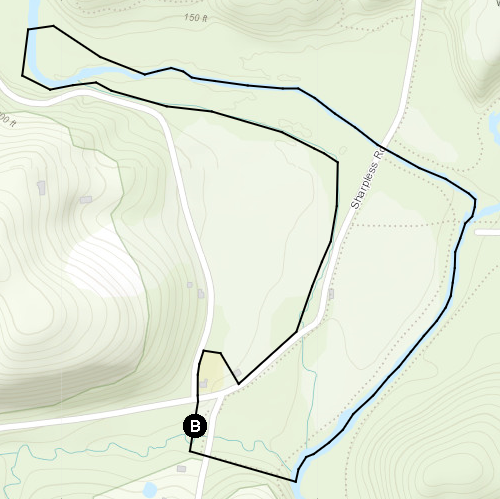
The Sexton's Barn[2] is positioned to the southwest of the Sexton's House. It is built on a field stone foundation and fronts to the north. It is a two story gable end building with a single story enclosed shed roof addition to the east and an open shed roof addition to the south. The northwest corner post has deteriorated and the entire north wall has collapsed leaving the barn is in a ruinous state. The original timber barn measures 15 by 15 feet and is sheathed in loosely fitted vertical siding measuring 14 inches in width. A wooden shingle roof has been covered with modern tin roofing material. |
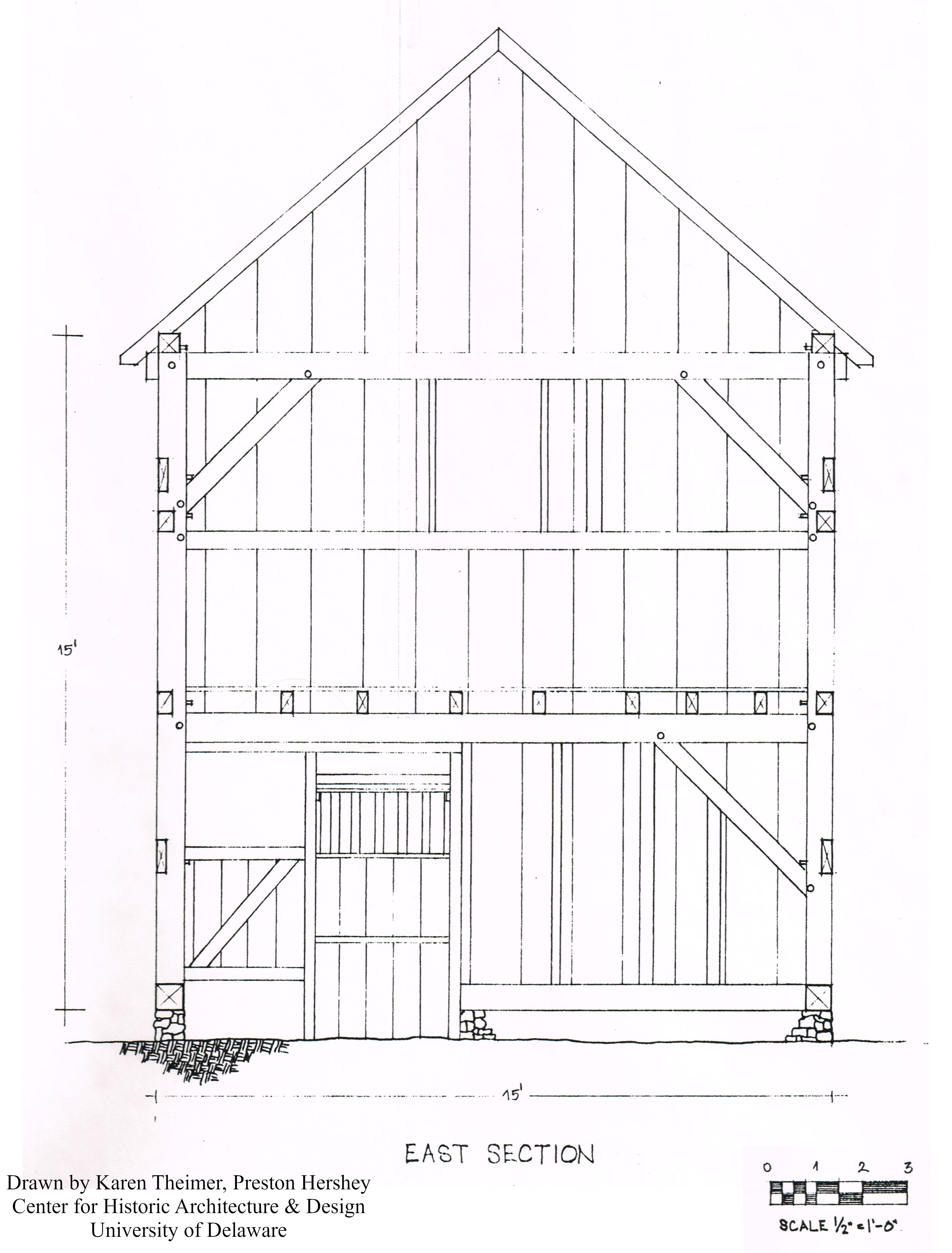
The north elevation is fractured by the protrusion of the added stable (enclosed shed roof addition). Entry to the barn is off center to the east and only indicated by the opening in the foundation and sill plate. The stable opening on this side consists of a half stable door (no opening exists in the west elevation). Vertical siding has a horizontal break along the gable end tie beam. The foundation is not broken along the south side, but two door openings are present. At the southwest corner, the first door is indicated by the absences of the up brace from the corner post and lack of siding. The second is off center to the east. Between this door and the original corner is a small hole in the siding. Evidence from the joinery under the corner post suggests that the sill plate ran the entire length of the side but is no longer in place. The sill plate is well worn in the second doorway. A shed addition to the east is constructed flush with this elevation and incorporates a window opening. The foundation and sill plate of original structure on the east side are open from just beyond the midpoint to the northeast comer creating the largest opening to the interior of the timber frame team. This feature presently holds a wooden feeding bin. The east gable end has a second floor window above the shed roof addition.
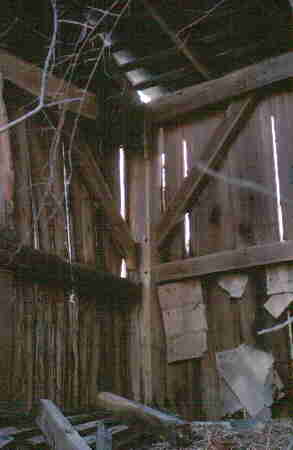
Detail: Post and Beam Construction, SE Corner
(photo credit: David Hawk)
The interior of the barn is highlighted by the joinery of the timber frame construction which is scarred by vertical saw marks[3]. Four corner posts rise from the sills connected by a stub tenon and mortise. Forces of gravity hold this joint together. It is unique to the structure because it is the only joint found without a peg. Up braces connecting the corner posts to the girts, intermediate plates, tie beams and plates utilize the blind mortise and tenon joint. These members are coupled to the corner posts with this system of joinery, also. Floor joists run east-west and are slightly notched creating a lap joint on the gable end girts and toe nailed into place. Tie beams at the gable end are united to the corner posts with an extended tenon and open mortise joint. The tie beams returns to their original dimensions after clearing the mortise cut. Plates are set on top of the tie beams and pegged to the corner post through a stub tenon and mortise joint. The rafters are abutted to the plate by a step-lapped rafter seat connection creating a shallow eve. Single story studs are found without regularity and toe-nailed into place. The stud at the southwest door jam is tenoned into the girt.
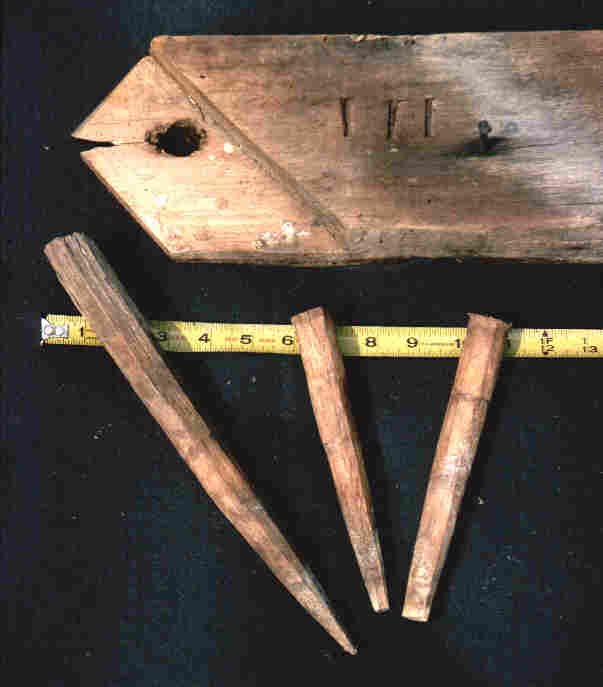
Cross-brace marked "III" with Tenon and Treenails (Trunnels)
(photo credit: David Hawk)
Notes (by David Hawk)
| [1] | The barn was demolished by WCWA volunteers shortly after the documentation was completed. The intention was to rebuild it, however only the foundation was rebuilt and the rest of the project was never completed. ↩ | |
| [2] | Local legend sometimes refers to this the "Sexton's Carriage House". It is unlikely that it was ever used as a carriage house simply because it was too small. The dirt floor was surrounded by a low sill, and the only opening in the sill was too narrow to admit a carriage. This stucture was never more than a small barn that may have provided shelter for a few horses or cows. ↩ | |
| [3] |
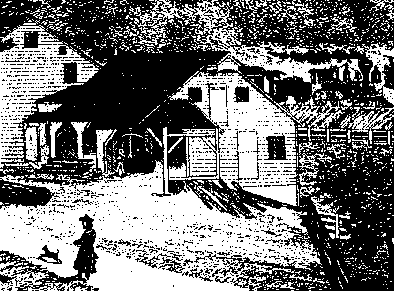
Yeatman's Sawmill |
It is likely that the timber for the barn was cut at the nearby Yeatman's Saw Mill which had a vertical saw at that time. This can be seen upon close examination of the drawing from Futhey & Cope (1881). ↩ |